


WONDER | High School
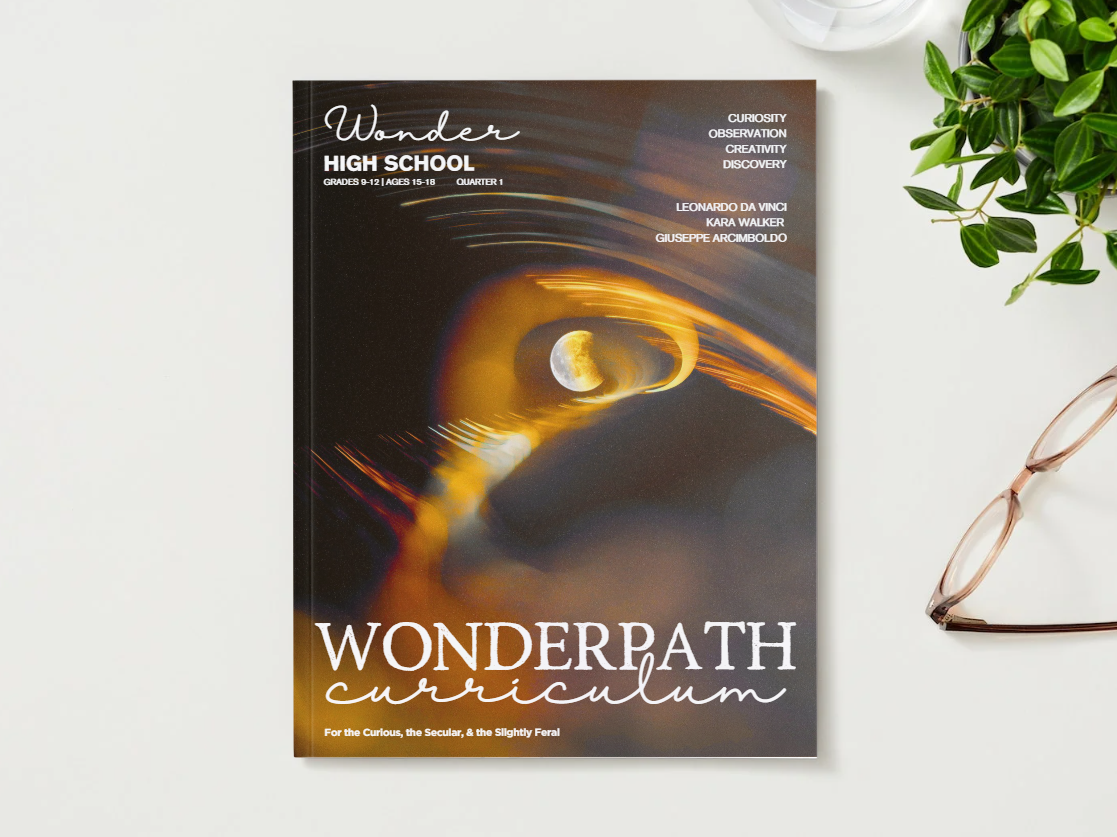


WONDER | High School

Ages 14 to 18
What happens when wonder grows up?
Wonder returns a final time, and at High School it is no longer soft. The learner who once wondered out loud, then asked why, then began to think, is now ready to interrogate. What lives in the stories we have been told, and the ones we have been denied? Who gets to tell them? Who gets left out? High School Wonder is built for young adults who can hold discomfort, weigh a source, and argue a position. This is the last turn of the spiral, the widest and the deepest, and it is where a thinker becomes a scholar.
Wonderpath is a sixteen-year journey, and High School is where it culminates: college-ready, intellectually rich, rigorous but never dry. Demanding, and still wonder-filled.
One book, the reading and the doing together
Wonder High School is a single volume. The textbook is the workbook. Nothing separate to buy or manage, no teacher guide sold apart from the book itself. You read from it and you work in it, all in one place.
Three artists, one a month
Wonder High School follows three lives across three months, one artist at a time. Leonardo da Vinci, whose notebooks remain the standard for a curious mind. Giuseppe Arcimboldo, whose faces built from fruit, flowers, and fish turn portraiture into riddle and provocation. And Kara Walker, whose stark cut-paper silhouettes force American history into the light and refuse to look away. Each artist holds a full month, a doorway into looking, interpreting, critiquing, and arguing, before the learner moves on to the next.
A chapter a month, and a reckoning
Each artist's month is a living biography built for college-level appetite, and some of it is heavy on purpose. The Kara Walker month, The Theater of Shadows, is the hardest in the book, and it earns it. Its big idea: art can confront the past and change how we see the present. Its guiding question: how can art hold a mirror to the stories we have been told, and the ones we have been denied. Walker's work moves through the most painful parts of American history, slavery, racism, gender, and power, and it does not offer easy answers. It disrupts. It haunts. The unit is not about memorizing dates. It is about looking deeply, asking why, and noticing what lives in the shadows of our world and our own minds.
A week, built out in full
Each week opens with a weekly focus and a genuine day-by-day breakdown. Walker's first week, Who Tells the Story, runs five days: a living biography chapter, Becoming a Shadow Teller, with sidebars defining silhouette art, antebellum, and historical narrative; an art and identity day, Cut From the Same Cloth, on silhouette portraiture, anonymity, and class; a visual literacy day studying Walker's 1994 work Gone and the ideas of satire, appropriation, and subversion; a Wonder Lab studio day for cut-paper narrative collage; and a reflection day returning to the week's question, who gets to tell the story. Every week names its concepts introduced and the portfolio pieces a student walks away with.
Woven together, never siloed
Around each artist, High School integrates college-preparatory work across disciplines, all still carried by narrative. The Walker chapters alone move through visual literacy and critical interpretation, learning to read meaning made through omission, symbolism, and negative space; primary source study of Walker's own shadowplay and storylines; historical research in History Cut from the Page, decoding antebellum imagery, propaganda, and resistance narratives to see what Walker appropriates, inverts, or destroys; a visual history timeline of imagery, power, and erasure; and synthesis work, Through the Shadows, where students articulate a personal position in writing and in discussion. Art, history, literature, and social critique, held on one line of inquiry.
The Wonder Journal
Reflective and critical writing sized for a young adult finding their own voice. What stories shaped how you see yourself, and who told them. What someone would misunderstand about you if they only saw your outline. The prompts ask for honesty and for argument in equal measure.
Words to argue with
Academic vocabulary a learner absorbs through use and context, the critical and art-historical language of college-level humanities, silhouette and satire, appropriation and subversion, narrative and erasure.
The four movements, built into the book
Woven through every chapter are the four movements that run the length of Wonderpath, entry, evidence, uncertainty, and expression, pitched for the High School scholar. At this tier that means evaluating sources, sitting honestly and rigorously with what remains contested, and building a defensible interpretation or a finished artwork in response. The book meets a learner where they are rather than where a grade level says they should be.
Portfolio and Capstone
Every week builds portfolio pieces, silhouette self-portraits, cut-paper collages, artist response entries, that accumulate into real work. Across the semester this becomes a body of interdisciplinary study blending art, research, writing, and critique, the kind of independent, portfolio-ready scholarship that prepares a student for college inquiry and professional presentation.
Who it's for
Secular homeschoolers, eclectic and worldschooling families, homeschool co-ops, and classrooms looking for a rigorous, inspired humanities elective. Built for self-directed young adults ready to meet hard history and harder questions with curiosity, clarity, and courage.
What we promise
Every fact sourced. Every culture treated with care. Honest about what scholars do not know, and honest about what history has done. Globally inclusive, never whitewashed, secular throughout. Academic rigor carried in warm, human prose, demanding but never dry. Curious, secular, and beautifully feral.
The short version
- What: Wonder High School, a single book that is both textbook and workbook. One volume, no separate workbook or teacher guide.
- Who: Learners ages 14 to 18, self-directed young adults, homeschool co-ops, and classrooms wanting a rigorous humanities elective. Secular homeschoolers, eclectic, and worldschooling families.
- The artists: Leonardo da Vinci, Giuseppe Arcimboldo, and Kara Walker. One artist per month.
- When: A living biography chapter a week, one artist a month, across a full semester of Wonder.
- How it works: Weekly focus with full day-by-day breakdowns, primary source study, visual literacy and critical interpretation, historical research, and reflective and argumentative writing across art, history, literature, and social critique.
- Built in: Academic vocabulary, the four Wonderpath movements (entry, evidence, uncertainty, expression), weekly portfolio pieces, and a semester-long body of portfolio-ready, college-preparatory work.
- Why: Because wonder, grown up, becomes the courage to interrogate. This is the final turn of a sixteen-year spiral, and it is where a thinker becomes a scholar.
Wonder at this level stops being comfortable. It becomes the discipline of looking directly at something difficult and staying curious anyway.